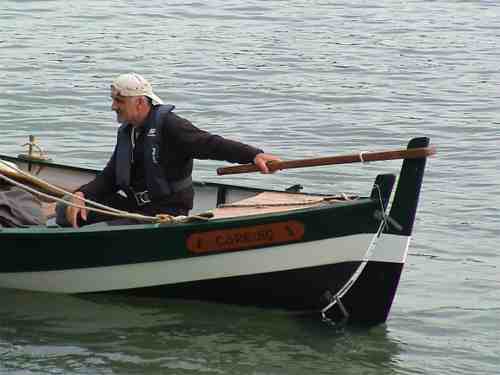
These pages are mainly about boats which are light enough for the crew to carry up a beach, but we can't resist this photo of Patrice at the helm of Caredig, a Ness Yole beautifully reinterpreted by Charpentiers Réunis of La Ciotat as a plywood kit. An open boat 22 ft 7 in long, she is large enough to carry six people in comfort but will float in knee-deep water. The Ness Yole is primarily a sailing boat, with a solid timber mast and gaff to carry two large sails, but if the wind dies it can be rowed by up to six people.
See previous page for:
• Seaworthy Small Craft
• Sea Kayakers & Their Other Boats
• Sailing Dinghies For Exposed Waters
• Rowing Boats For Exposed Waters
Rowing-sailing boats
They boarded the vessel, beached on the shingle
By the curling tide. Straightway they shoved her off.
They ran up the white sail. And the wind caught her,
The biting wind whipped her over the waves.
Like a strong bird the swan-boat winged her way
Over the grey Baltic, the wintry whale-road,
Till the lookout sighted land - a sickle of fair sand,
And glittering white cliffs. The keel struck
The shingle.
Ian Serraillier's translation of the Beowulf epic
Designers of sail-and-oar boats have to reach a compromise between the ability to sail to windward on exposed waters, or the different characteristics that make the boat a joy to row all day. A short, wide, heavy boat won't glide through the water with the occasional touch on the oars. A true rowing boat needs:
- a long, slim hull
- light weight, which means the least width, depth and equipment you can get away with.
It's usually possible to put a small sailing rig on a boat intended purely for rowing, and it'll go beautifully with the wind coming from the side. However you'll need fast reactions and the ability to swim, and if you want to go upwind or directly downwind it's probably time to take the mast down. A true sailing boat is a different beast which must have:
- a wide hull with a squarer, more flat-bottomed cross-section ("firm bilges").
- high sides (or a full deck and a wet ride like a Laser) so it doesn't fill with water when the wind makes it heel over to a 30 degree angle.
- short length so it can turn quickly when tacking to windward.
- underwater control surfaces - a rudder for steering, and another vertical underwater fin to stop the wind pushing the boat sideways over the water. This is usually a centerboard or daggerboard, raised and lowered through a vertical slot in the hull. See for example the Laser dinghy. Even when the centerboard is retracted, the slot creates enough drag to spoil a rower's day.
The cross-sectional drawings, below, are all to the same scale. The left side of each drawing is a view from the front and the right is from the rear. The two boats on the left are designed to be rowed. The two on the right are sailing boats which can be rowed if necessary. As sailing boats, they both have centerboards of which only a stub is shown in these drawings.
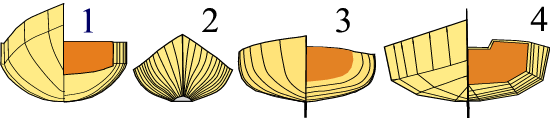
1. A 19 foot long Aran curragh designed to be rowed by two people. It may occasionally carry a small sailing rig in fine weather but has nothing underwater to resist leeway.
2. A 16 foot Adirondack Guideboat, a lovely boat intended purely for rowing. It can easily outpace a sea kayak when rowed by one person. Pointed at both ends ("double ended") it looks like a Canadian canoe but with higher ends.
3. An 11 foot Uffa Fox sailing tender for a yacht.
4. A modern 17 foot boat designed to win raids.
 Every lover of small boats has their own view about the perfect sailing-rowing compromise. such as this cute 16 foot 4" double-ended boat seen in Brittany.
Several adventurous coastal cruises have been made in boats about 17 feet long, 47 in wide, pointed at both ends, with the seaworthy hull shape of a miniature whaleboat. Not too big to row solo, not too small for two to row. A sufficiently stable shape in cross-section to carry a very small sailing rig during perfect sailing weather. Both ends closed off as buoyancy tanks. The center crammed with inflated air bags which can be adjusted to leave room for one crew, or two crew, or crew plus a heavy load of camping equipment. Enough freeboard to row in rough water without starting to fill with water, not so much as to make it the plaything of high winds. Both sail and mast can be taken down in seconds when there is too much wind.
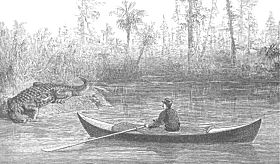 In 1874-75, Nathaniel Bishop rowed a boat of roughly these dimensions 2500 miles from Quebec to the Gulf of Mexico. Bishop's was actually a one-man boat, and for a small man at that. His Maria Theresa, shown here in a close encounter with an alligator, was 14 feet long and 28 inches wide, only a little wider than a kayak. It was very light because it was laminated from layers of paper. Voyage of the Paper Canoe, N H Bishop, 1879, various re-prints. Full version free online at www.eldritchpress.org
Not many years later the naval architect Frederick 'Fritz' Fenger sailed a similar but more sophisticated boat along the Antilles island chain. Built for him by WF Stevens of Marblehead, Massachusetts, his Yakaboo had very little freeboard and was double-ended, so perhaps we can call her a sailing canoe even though she was too wide to paddle easily. She was a lovely boat to row, but a very wet ride under sail. His book Alone in the Caribbean (published by George Doran, 1917, various re-prints) is available free online at Craig O'Donnell's The Cheap Pages. Last time we looked, the link was at http://www.thecheappages.com/alone_fenger/alone_contents.html
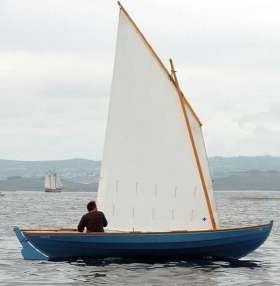 |
Many people feel that the best rowing-sailing boat is a dory, not the old Grand Banks fisherman's dory but one of its sophisticated descendants with a rounded cross-section. The Swampscott dory, for example, was very popular in the 19th century as a light sailing boat for racing in sheltered waters. The William Chamberlain / John Gardner gunning dory mentioned on the previous page has a lovely shape and excellent performance in rough water. |
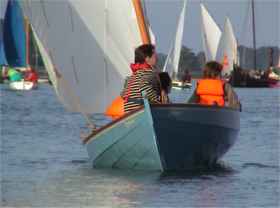 |
It looks not unlike Youkou-Lili, shown here in two pictures from the side and end-on. Youkou-Lili is one of the long-term personal favourites of her designer François Vivier, and construction plans are available from www.vivierboats.com |
For more about rowing-sailing dories, see:
• The Dory - A Practical Guide to Some Build-Able Beach Cruisers. Thom Vetromile. This is a free download. Last time we looked, the link was www.scribd.com/doc/69485143/Dory-Story
• The Dory Book mentioned on the previous page
The websites and books listed here include much about rowing-sailing boats, and every summer you can see them taking part in raids and regattas. A raid is a long-distance race across varying terrain and/or water. A traditional boat raid is a gathering of similar boats which race from one place to another using oar and sail, usually over several days. It's easier to join in than it is to organize your own adventure trip, and the entry fee sometimes covers food and accommodation at each stop. Most raids are more about taking part than winning.
- The Scottish Raid / Great Glen Raid, Scotland, www.sailcaledonia.org
- Blekinge Archipelago Raid, Sweden
- Raid Finland
- Erdre Regatta, France, www.rendezvouserdre.com
- Semaine du Golfe du Morbihan, France, www.semainedugolfe.asso.fr
- Shipyard Raid, Canada
- and the less traditional Everglades Challenge, USA, www.watertribe.com
Sailing canoes for exposed waters
 The noted yacht designer and writer L Francis Herreshoff said "it is my opinion that the double-paddle sailing canoe gives the most fun for the money of any type of boat a person can possess, and I must say that it is my favorite form of aquatic sport". Other well-known yacht and multihull designers with a fondness for sailing canoes include Frederick Fenger, Uffa Fox, John Gardner, Phil Bolger, Jim Brown, Iain Oughtred and the Gougeon brothers.
When we say sailing canoe, we don't mean a Canadian canoe with a temporary bolt -on sailing rig but the dedicated sailing craft which evolved from it.
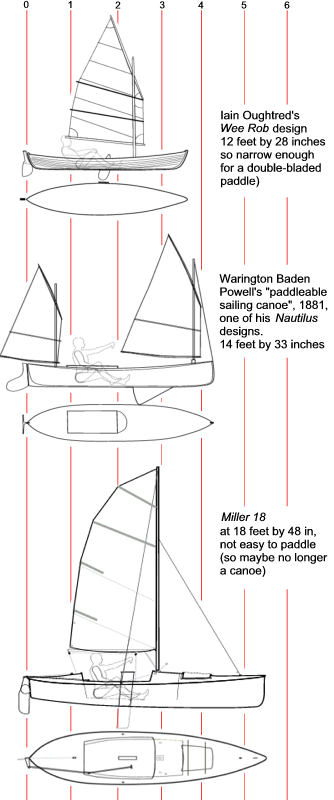
Sailing canoes come in all levels of seaworthiness. Iain Oughtred's Wee Rob is the smallest of his sailing canoe designs. It's very cute, is fun to sail in nice weather on sheltered waters, and paddles well if there's no wind.
Intermediate boats like High Horton's 15 feet 5 inch Bufflehead give gentle fun on gentle days or excitement when the wind gets stronger, unless you drop the masts and sails and get the paddle out instead. Heavier decked canoes like this Nautilus have made many coastal trips.
One person can sleep aboard the bigger canoes when they're drawn up on the beach or even at anchor. The Miller 18 drawn here was a contender in the Everglades Challenge 2012 and has just enough room for two people to spend the occasional night under the foredeck. In fine summer weather in Sweden and Finland, sailors often stop in a sheltered location, put up a canvas boom tent, and sleep aboard their 18 to nearly 20 foot Scandinavian sailing canoes.
Some canoe history
The Canadian canoe has been around ever since North American native peoples discovered that birch bark and spruce could be turned into a boat. See Building in Birchbark. Canoe users have always helped their craft along on downwind trips by holding up a bush or a blanket. Today, adding a temporary bolt-on rig for lake sailing is a popular summer activity.
In the 19th century, leisure users started to put a very small mast and sail onto canoes and short wide kayaks. At first these were gentle little craft up to about 15 feet long that you could sail downwind, or across the wind, while seated inside the cockpit. You could carry one around on your shoulder quite easily.
Designs evolved rapidly after that. See Sailing Canoes in 1895. Many 19th century canoeists preferred wider, heavier canoes with two masts. Not so good for paddling, but much better at sailing. They often had a small mast and sail for touring, and a larger mast and sail which they used in club races, sitting on the edge of the canoe and leaning backwards to keep the canoe upright against the force of the wind in the sail.
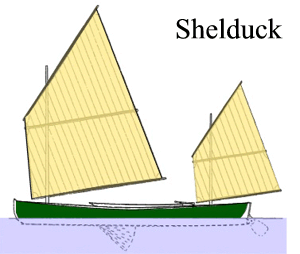 |
Shelduck is a nice example of this type. She's 16 feet 5 inches long but only 32.5 inches wide. (A 16 foot racing dinghy would be anything from 59-71 inches wide.) She has two masts and carries 62 square feet of sail for cruising. For racing she can carry 84 square feet of sail, which is a lot for such a slim boat but the short masts and square sails mean that the centre of effort is low compared to a modern racing dinghy. The cruising sails area can easily be reefed to reduce their area, and if the wind gets too strong or Shelduck is to be paddled directly upwind, her masts can be taken down on the water. She is suitable for cruising on lakes, estuaries and wide rivers but a bit light and open for the sea. In light winds, you could sail Shelduck while seated in the cockpit. Sailing her to windward you must usually sit on the edge of the deck. |
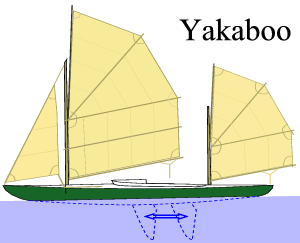 |
Some 19th century canoeists covered the entire boat with a deck so that no water would enter in a capsize. We mentioned Yakaboo's epic trip in the Caribbean. She is 17 feet long by 39 inches wide, which makes it easier to move her with a short pair of oars than a paddle. She has up to 80 square feet of sail. Yakaboo has real open-water ability as long as you don't mind getting wet. She rows very nicely. Compared to an International Laser sailing dinghy she has 5% more sail area and 27% less beam. Her sail area can be reduced at sea, but under full sail she is a wet, wet ride for experts only. You sail her seated on the gunwale with your feet in the cockpit. Fritz Fenger found it helped to have lots of heavy tinned food stowed low down. He had the builder give her a self-bailing cockpit which drains through a centreboard case. The centreboard can be moved fore and aft to change the centre of lateral resistance, which means no rudder is needed. |
In the late 19th century in Britain and the eastern United States, the sailing canoe was nearly as popular as the bicycle. The simplicity of the early sailing canoe was left behind as designs evolved in two directions, either towards more seaworthiness or towards racing speed on flat water. Racing enthusiasts found that wider canoes, flatter underneath, made the best sail racers; and that a canoeist could use a much larger sail if he tied a plank across the top of the canoe and sat on the upwind end. It's efficient, but the canoeist needs excellent balance and lightning reflexes.
Other sailors preferred cruising and they took the design in another direction. Their sailing canoes were made even wider and fitted with complex and efficient sailing rigs. Larger but genuinely seaworthy craft evolved. In the quest for speed and status some had iron or lead weights attached to the bottom to help stability. They had become micro yachts like this one. That line of development ended with the "canoe yawl" which really is a yacht, with a cabin and weighing well over a ton, nice-looking cruising boats as described on www.canoeyawl.org
After a few decades of cutting-edge design, a "sailing canoe" became a boat that was hard to paddle and either very hard to keep upright or very expensive to buy, and nearly everybody lost interest at that point. Today you can still find the extreme types of sailing canoe if you look hard enough (see below) but it's the simple, moderate sailing canoes that are enjoying a revival.
Moderate cruising canoes today
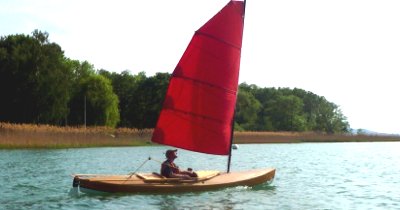 The canoe sailing boom started because people were inspired by small, light boats with small sailing rigs. It was easy to take them out, you could sail in only a few inches of water without worrying about rocks or scaring away the wildlife. You could really relax. These were the ones all those yacht designers loved.
This photo from Axel Schmid's site www.bootsbaugarage.ch shows Hugh Horton's Bufflehead design which is 15 feet 5 inches by 33 inches. The hull weighs 52 lbs, and total weight with sailing rig is 82 pounds.
The sailor is sitting in the canoe in armchair comfort. However if you want to sail a canoe to windward, especially on a windy day, you need to do something to resist the wind pressing on your sail. The closer to the wind you sail, the more it tries to capsize you.
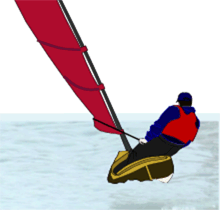 In a light and simple sailing canoe you can either take the sails down and start paddling, or sit up on the side deck and lean your body weight to windward. It's fun but you'll get very wet and maybe go for a swim.
As Hugh Horton says, Bufflehead is " a 50/50-canoe: sail when you can, paddle when you must” and Axel Schmid says “it can be sailed very wet and wild. Due to its small breadth, she needs either a prudent or very agile skipper. In spring and autumn, a dry suit or a wet suit is advisable.”
There are lots of nice designs suitable for cruising on lakes and estuaries. You can get sailing canoe plans from Selway Fisher and John Floutier Sailing. In the UK, you can buy complete boats from John Floutier Sailing or Solway Dory. In America, William Clements has built a number of high-quality wooden reproductions of the Victorian classics. www.boatbldr.com
Smaller sailing canoes designed to be equally good for paddling and sailing are often called 50:50 designs. Some have a deck to keep them from sinking in rough water or when heeled over, and we regard that as almost essential if they are to be used at sea. Verlen Kruger loves tough expedition canoes and is said to have paddled "more miles than any other man in the world". You'll find a link to the Kruger Canoes site at Kayarchy Shopping.
If you're interested in building a small or medium sailing canoe, something you can pick up and carry, have a look at the 12 foot Wee Rob design from Iain Oughtred, the 12 foot 8 inch Piccolo by the late Bob Baker, the Oughtred MacGregor which can be anything from 13 feet 6 inches to 17 foot 3 inches long, and the 15 foot 5 inch Bufflehead. Plans for these are available from Jordan Boats (plans for Wee Rob and MacGregor, pre-cut kits), Canoe Sailing Magazine (Bufflehead plans) and either Baker Boatworks or WoodenBoat magazine for Piccolo. For contact details see Kayarchy Shopping.
Extreme racing canoes today
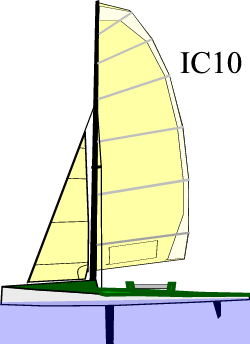 |
The unstable racing canoe survives as the International 10 Square Metre sailing canoe (IC10). This looks like a very skinny racing dinghy, with a sliding seat which enables the sailor to sit a long way out from the side of the hull. Although not as fast as a racing catamaran, sailing canoes seem even faster because you are perched on a narrow plank with water streaking past underneath. Definitely a one-person boat. There's a nice photo gallery on the French IC10 website at http://ic10.free.fr |
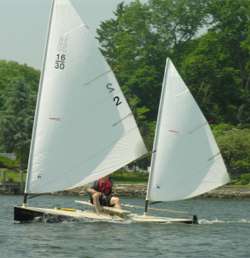 |
Smaller extreme sailing canoes, 16 feet long and 30 inches wide, are still sailing on lakes and bays in North America. Try a Internet image search on "sailing canoe" and "16-30". For plans for a plywood 16-30 sailing canoe like the two-masted version in the photo, contact John Summers. That'll be him out on the sliding seat. John says " there's some further information about the boat available on my blog at http://authenticboats.wordpress.com" |
Heavy cruising canoes today
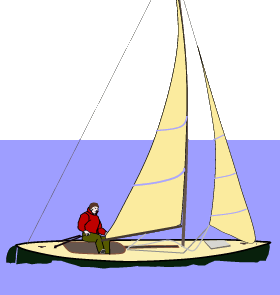 The Victorians had ballasted sailing canoes for cruising on exposed waters, for example some of Warington Baden Powell's Nautilus designs and Linton Hope's Coma China. Big, heavy, truly seaworthy sailing canoes are still popular in Sweden and Finland.
If those words make you think of endless forests, wolves and snow, you may be surprised to hear that much of Scandinavia has wonderful summers with very long days, a long, beautiful and empty coastline, and many islands, lakes and rivers.
In Sweden there seems to be at least one boat per person. Some Scandinavian sailing canoes are the size and weight of small dinghies, others are miniature yachts carrying over 400 pounds of lead on the bottom of the hull, like the one illustrated here. They carry big sails to match the ballast, so just like the smaller canoes you can sit in the cockpit in light winds, but you'll want to sit up on deck in gusty conditions or to go to windward so that your body-weight can help keep the boat upright. These canoes are fitted with a sitting-board so you can get your weight to windward without dragging your backside in the water like an International Laser sailor.
The sailing canoes in the Swedish classes listed below can be paddled short distances, or rowed, but they're usually sailed. As far as we can make out without a Swedish-English translator, the main classes are:
- B-class. Basically a 13 foot sailing dinghy for teenagers. Has a single quite large sail. No ballast. Max sail area 86 square feet.
- C-class - 15 feet 11 inches to 17 feet 1 inch long, min 176 pounds ballast. Max sail area 107 square feet.
- D-class - 18 feet to 19 foot 8 inches long, min 518 pounds ballast. Max sail area 140 square feet. Here's a 2013 update from Torsten Sörvik, designer and builder of the Lunne and Tejst sailing canoes in Sweden: "Older D-canoes have a weight of 500-600kg. Around 1960 the class regulations were changed and from then and until 2007 the minimum weight, ballast included was 235kg. In 2007 we adjusted the regulations, mainly concering the minimum weight, it was raised to 360kg hull and ballast". Thanks, Torsten.
- E- class - 18 feet to 19 foot 8 inches long, min 286 pounds ballast. Max sail area 140 square feet.
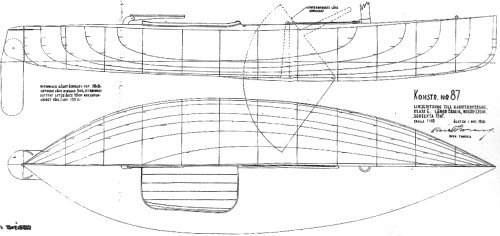 D-class and E-class canoes are very expensive and too heavy to transport on the roof of your car, but the D-class in particular is seaworthy and some designs let you sleep aboard in summer. They can have either a cruising rig with two masts and relatively small sails or a racing rig for use near a sailing club, with a single tall mast and a high-tech sail. They can take two but are usually sailed solo. Two or three or four sailing canoes will often go cruising together, mooring in the same spot to spend the night, and stretching a tarpaulin over the cockpit (a boom tent) for shelter.
For evocative images of Scandinavian sailing canoes against a background of whaleback rocks and dark pines, try Google image searches on "kanotsegling" and "kanotseglare" (Sweden) and "purjekanootti" (Finland). There's a nice site at www.kanoottipurjehtijat.fi
For more information
There's a Kayarchy article here: Sailing Canoes in 1895, which has a chapter from the Manual of Yacht & Boat Sailing by Dixon Kemp, the lines of several Nautilus canoes and those of Linton Hope's Royal Canoe Club B-Class cruiser Coma China.
Sailing canoes are also covered in the books previously listed, in particular various books by Uffa Fox who invented the modern racing dinghy and helped make sailing canoes into unstable racing machines; and Sail & Oar by John Leather, a naval architect with a fondness for seaworthy cruising canoes. And there's plenty online, including entire illustrated books about construction and technique:—
- Canoe Sailing Magazine, online at www.canoesailingmagazine.com or www.skinnyhull.com
- The International Canoe website has links to a lot of online sailing canoe history. Last time we looked, the page was here: www.intcanoe.org/iclife/history.html
- The same website also has a gallery of lines drawings for sailing canoes of all sorts, dating from 1870 to 1992 and ranging from heavy sea cruisers to the sort of lightweight racing machine that falls over as soon as you put the mast up. www.intcanoe.org/iclife/hist/deckedsailingcanoeindex.htm
- Canoe Sailing Resources 2010 is a great portal.
- American Canoe Association. There's a nice website for the National Sailing Committee.
- Canoe & Boat Building for Amateurs by WP Stephens. Free online thanks to Dragonfly Canoe Works. Last time we looked, the link to this documents was at www.dragonflycanoe.com/stephens/index.html. Contains plans for all types from the paddling canoe with a small sailing rig; through the heavy ballasted cruising canoe for open waters; to the Vesper class which only an athlete could keep upright.
- Practical Canoeing: A Treatise on the Management & Handling of Canoes by Charles Penrose ("Tiphys"), 1888, Norie & Wilson; 1889, Field & Stream Publishing. This is online thanks to Craig O'Donnell and his site The Cheap Pages. Last time we looked, the link was at http://www.thecheappages.com/tiphys/Practical_1.html