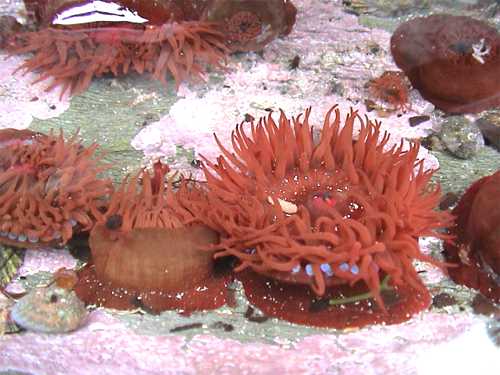
Beadlet anemones Actinia equina. Not a hazard.
Solo kayaking
"Whenever I find myself growing grim about the mouth; whenever it is a damp drizzly November in my soul; whenever... it requires a strong moral principle to prevent me from deliberately stepping into the street and methodically knocking people's hats off - then I account it high time to get to sea as soon as I can".
Herman Melville, Moby Dick, 1851
There are times when you just want to hear waves, wind and sea-birds, not your friends talking about work and relationships.
Scuba diving and solo kayaking are the best ways to see marine wildlife. Many experienced sea kayakers make the choice to go solo paddling and have no problems at all. Solo kayakers have paddled round Newfoundland, Scotland, Britain, Ireland, Iceland, New Zealand, Japan, the Mediterranean and even Australia.
A solo sea kayaker is at less risk than when riding a bicycle or a horse, and puts other people at far less risk than if riding a jet ski or driving a vehicle.
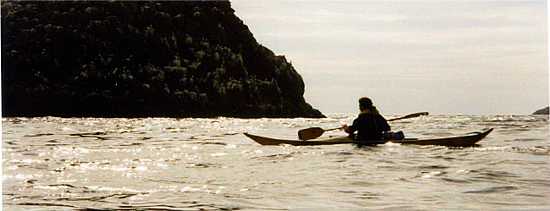
BCU handbooks used to say "less than three there never should be". This is good advice because of the self-rescue ability of a trained group. The latest edition of the BCU handbook indicates that 'no solo kayaking' is more of a guideline than a rule. Many kayakers who like to go out solo find that their most hazardous moments are when they do go out with a group, and they have to rescue those who are inadequately equipped and fail to roll.
If you go solo kayaking, you will want to practice your kayak roll often, at sea and in surf, and you may wish to fit out your kayak with extra care. The main thing to fit is lots of positive flotation. Probably you will want a spare paddle on the front deck where you can easily reach it while upside down. You can carry a paddle float and practice using it for solo self-rescue. If you can attach your paddle float as a rigid rescue outrigger you will be able to use a portable pump to empty out your cockpit if it floods at sea. You could consider having a built-in foot pump.
Infections
Here's a brief discussion. If you want to know more, see Simon Dawson's Canoeist Pathogenic Illness Guide.
Upset stomach
If you go swimming or kayaking within three miles of an urban area, you are quite likely to get 24 hours of diarrhea and vomiting from exposure to raw sewage. It is normal to find some fecal coliform and fecal streptococci on even famous swimming beaches. In other words, nobody expects an entirely sewage-free sea. Kayakers become almost immune after a few years of regular exposure. But be careful where you collect shellfish.
Another potential source of upset stomach is drinking water. On most kayak trips you can easily carry enough clean water for drinking. On longer camping trips you may need to take a water filter and pre-filter with you.
Tetanus
Tetanus is not particularly associated with the sea or coast, but kayakers often get cuts on their hands or step on sharp objects. It is worth making sure that you have an up-to-date vaccination against tetanus.
Weil's Disease/ leptospirosis
Very rare amongst sea kayakers, almost unknown amongst sea kayakers. Agricultural workers are at particular risk. It is a bacterial infection so it can be treated with antibiotics if recognized early enough.
Transmitted by rat urine, which is often present on harbor surfaces. It may find its way into the body through a cut or through the eyes or mouth. Symptoms in the first phase come on after about four days and resemble flu with high temperature, aches, headache. The second phase may start as much as 14 days after exposure and include one or more of liver failure (jaundice), kidney failure or meningitis. Weil's Disease is not detectable by ordinary blood tests so an ELISA assay is needed. This generally means sending a blood sample to a distant lab.
Lyme Disease
Uncommon but increasing in the USA and Europe. Can be transmitted by deer ticks which live in heather or bracken. Keep an eye out for infected tick bites, although in many cases of confirmed Lyme Disease the patient does not recall having been bitten.
In four out of five cases of Lyme Disease the bite becomes inflamed and surrounded by a broad red rash. Classic signs and symptoms resemble flu with high temperature, aches and headache and a feeling of being generally unwell.
As the disease progresses there may be other rash sites elsewhere on the body, and one or more of a very wide range of symptoms. The list of possible symptoms includes photosensitivity, arthritis in the knees, facial paralysis and memory loss. It is notoriously difficult to diagnose Lyme Disease because blood tests often return a false negative result.
The good news is that if you go get a tick (which looks like a freckle until you see the tiny little legs) and you remove it within 36 hours, you should be safe. They are usually on your legs but the more energetic ones may reach your pubic hair or inaccessible parts of your back.
Again, a bacterial infection so it can be treated with antibiotics if recognized early enough.
Mud & quicksand
Not usually a hazard, but they can be. If you have to cross a suspect piece of beach, you may need to stand astride your kayak and use it as a sledge.
Mud
When a big river laden with silt enters an estuary, it slows down and dumps the sediment. If the estuary is sheltered it may fill up with mud that's too thin to cultivate but too thick to navigate. It gets in your boots, it gets in your hair, it gets in your car, but it can also be deep. Really deep.
In England, the mud of the Severn Estuary is legendary. Combined with an extremely high tidal range, miles of deep sticky mud make life particularly challenging for anybody who tries to get up or down the riverbank at the mouth of the River Wye. Further up the Severn Estuary, the sand-mud beaches can be soft and sticky in places. An entire girl's netball team had to be rescued from mud at Brean Down in 2006. And not far away in the Exe estuary there's a lot of mud. It's very popular with wading birds and most of it is firm enough to walk on. Just at the entrance to the Exeter Ship Canal, though, the surface of the mud looks suspiciously shiny. Anybody who falls in just disappears. It's about as firm as thick soup and more than seven feet deep.
Quicksand
There's also quicksand in a few places around the coast. It's a lot more common in fiction than it is in real life, but it does exist.
Some say there are a few patches along the coast of Florida and the Carolinas. It's a very real hazard in a couple of places in Britain - Morecambe Bay and the Solway Firth. The Firth is on the border of England and Scotland, and it's a huge beautiful bay filled with sand where some patches of wet sand behave in a very strange way. It's all very technical, about thixotropy. The sand is fairly firm when a seabird or a small dog walks on it, but with a heavier load it turns almost instantly into wet cement. Your feet sink in, then your legs. If you stand on deep quicksand for more than a few seconds you will, at the very least, lose your boots in your struggles to escape.
If you can't get out, you drown when the tide comes in. It's even difficult to get a casualty out during a rescue exercise. The rescuers are on the scene in a few minutes, equipped with a hovercraft, wooden planks to work from and a hoist, but it still takes time to get the casualty out. The trick is not to pull him in half. If the rescuers can pump water into the sand around his legs, that's the easiest way.
Other hazards and pests
Biting insects
Is anywhere in the world free of them? See Insect Equipment.
Poison ivy
On the edges of woodland from southern Canada to Mexico you may encounter poison ivy (Toxicodendron radicans) growing as ground cover, or as a bush up to 10 feet tall (poison oak) or as a creeper that closely resembles Virginia creeper. If you touch it, the effects are often unpleasant, may last several weeks and in a severe case may require medical attention. If you do come into contact with it, try to wash it off immediately with dishwashing soap and water. For more information and ID photos click here.
Sharks
At some times of year, sea kayakers in California and even Massachusetts have occasional close encounters with Great Whites, although these have very seldom gone beyond the shark leaving a set of toothmarks in the underside of the kayak before swimming off again.
Regions which have Great White and other potentially aggressive sharks are likely to get more attacks in future. This is partly because of the increasing number of sea kayakers, many of whom like to get close to shark prey animals such as sea lions, and partly because the shark's feeding habits are affected by changes in the marine environment.
For general information, see the International Shark Attack File maintained by the Florida Museum of Natural History, and for some practical advice aimed at California sea kayakers, see this article by Nate Burley and Aaron M. King.
Bears
Despite the myth they very seldom injure humans.
Polar bears are present in Alaska, Arctic Canada and parts of Greenland. In the last thirty years they have killed eight people in Canada (one of whom was a teenager who had tracked the bear and was throwing rocks at it) and one in Alaska. Source - Polar Bears International. They have hardly ever regarded humans as prey but may do so in future, in areas where global warming means they have increasing difficulty catching seals.
Sea kayakers may encounter black or brown bears along the coasts of British Columbia, Alaska and some places round the Great Lakes. In North America as a whole, we are told that coastal brown bears, grizzly bears and black bears kill about three people a year. They hardly ever regard humans as prey, and we are told there has never been a recorded attack by a bear on a group of half a dozen people or more.
However if there is an unexpected meeting between bear and human, for instance on a narrow forest trail, the bear may attack especially if it has cubs to protect or has recently been harassed by a dog. Hungry bears are drawn to camp sites by the smell of food, garbage and some toiletries. If their visit is successful they will get into the habit of raiding camps and accidents may happen. To avoid this, campers should keep tent sites clean and cache food up out of reach of bears.
If a bear charges a human it is usually a bluff. There is evidence that shooting at a charging bear can turn a bluff into a real charge and lead to a mauling. The Sierra Club recommends carrying a cayenne pepper spray in case of confrontation with a grizzly bear. Click here for the article.
Hunters
Every year, more people are killed by hunters in Pennsylvania alone than by bears in the whole of North America. And bears don't shoot you while you're driving along the highway. You can protect yourself to some extent by wearing fluorescent orange clothing when in the woods. And bulletproofing your car. We particularly enjoyed the International Hunter Educatoin[sic] Association stats page.
Red tides
During calm summer weather, plankton blooms in certain areas can turn the water reddish-brown. Some blooms are of plankton species which, if ingested by certain shellfish which are then eaten by humans, can cause paralytic shellfish poisoning (PSP).
Risk areas run from the Canadian Maritimes to New England; from the Gulf of Mexico along the west Florida coast; and right up the Pacific coast from California to Alaska. Warnings are broadcast on NOAA Weather Radio and most areas also have telephone hotlines.
Other local hazards
For a practical approach to dangerous animals and plants of the Pacific, the Hawaiian Lifeguard Association had useful information online. The link we had to this no longer works, but you can try www.hawaiianlifeguardassociation.com
Unlikely hazards
It is useful to be aware of rare hazards, but not if that awareness stops you doing worthwhile things. The Mediterranean has sea urchins covered in sharp but fragile spines. South Africa has Great White sharks which have been known to stalk sea kayakers. Australia has snakes, box jellyfish, the stonefish, saltwater crocodiles and stingrays. Fiji gets tropical cyclones. South-east Asia has falling coconuts and various toxic sea creatures including a lethal cone snail.
Each of the half-dozen things listed below has been described as a real hazard of sea kayaking. We'll throw down the gauntlet by saying that they are either so unlikely that they can be disregarded, or trivial. Most of them can be avoided only by staying home. And if you do stay home or go shopping, you are still at risk.
Sea kayaking has its hazards, but in more than a hundred man-years of kayaking, and despite some of the Kayarchy contributors either being physicians or being married to a physician, none of us has ever met anybody who has even heard a plausible story about a healthy kayaker suffering significantly from any of the following.
Jellyfish
Jellyfish are common and beautiful. Except for box jellies they rarely cause anything more than mild discomfort.
On the eastern seaboard of the USA and particularly in Chesapeake Bay you may at some times of the year encounter large numbers of the sea nettle (Chrysaora quinquecirrha). Its sting feels like sunburn or a bee sting. You may also encounter a Portuguese Man O'War (Physalia physalis) or the Lion's Mane (Cyanea capillata) which was demonized in a Sherlock Holmes story. However they are rare, large and look dangerous without actually being especially hazardous. Their stings have been compared to a bee sting or to being whipped with stinging nettles.
California surfers often report painful jellyfish stings. In the warmer waters of Hawaii a kayaker may encounter the genuinely dangerous sea wasp Carybdea alata, a variety of box jelly. For more, you could try www.808jellyfish.com
If stung, don't rub the skin because fragments can still sting you. Immediate treatment is by washing fragments of sting off your skin with water and sliding the edge of a knife blade or credit card over the skin to "shave off" any remaining fragments.
What about the folk remedy of applying vinegar? Advice on the Internet is contradictory. It seems that vinegar or acetic acid may help with box jelly stings but NOT those of Portuguese Men O'War as they will simply cause many cells still in contact with the skin to fire their toxins. Cold water will reduce the pain, which should go away on its own fairly quickly. If pain persists, anti-histamines and oral steroids may be prescribed by a physician.
In south-east Asia and Australia various sorts of box jellyfish are said to have caused more than 5000 deaths in the last sixty years. Carybdea alata and Chironex fleckeri are quite common around Australia, especially in northern waters in summer where they cause at least one death every year. The record annual toll is said to be 67 deaths in one year. It shares Australian waters with the Irukandji (Carukua barnesi), a similar dangerous species.
If jellyfish are a significant problem where you come from, please let us know the species name, the time and area where a sea kayaker may encounter them, and the recommended treatment.
Killer whales
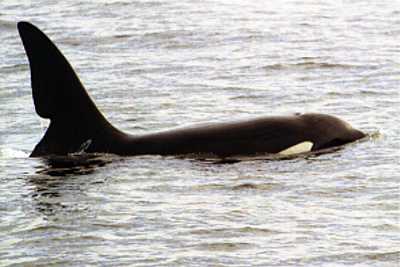 Orcinus orca. Six tons, 40 mph and carnivorous. We can vouch for them being terrifying up close.
You just can't help thinking about the nature documentary where orca play volleyball with sea lions in Argentina. Using the sea lion as the ball.
Their brains are four times bigger than ours and they live as long as we do, so they don't make many mistakes. If kept in captivity they have been known to kill their handlers, but there seems to be no recorded case of a kayaker being harassed or eaten by one. The video on YouTube of an orca leaping high out of the water, landing on top of a sea kayak and taking it underwater for several seconds is a spoof by the advertising agency Wieden + Kennedy in an advertisement for a sports drink. www.youtube.com/watch?v=H2KBpauoDNs
Sunburn
Actually it's true that you can get fried on the water much faster than on land. See Clothing For Summer.
Numb feet
This can be avoided by making sure your kayak seat is a comfortable fit. See Kayak Seat.
Grumpy seals
Well, don't tease them.
Gull attack, lightning, hyperthermia (heatstroke), dehydration, barnacle cuts
Well, OK, but it's not like a barnacle is going to give you rabies. Did know a man who was eaten by a giant clam, though.
Getting sucked up
Some countries have regular forest fires which are fought by all possible means, including aircraft which scoop water up from lakes or the sea and dump it on the fire. So, don't waste time shaking your fist at the pilot if a cargo aircraft roars past just above your head while you are kayaking in British Columbia (or California or the Mediterranean) in summer. Turn to right angles from the aircraft's course and paddle like a maniac until you are 400 yards away. Because he'll be coming back in 2 minutes with his scoop open.
Known as Canadairs, ducks, scoopers or water bombers they can pick up 6 tons of water in 400 yards. Some four-propellor water bombers are in service but usually you will see the Canadair CL-215 or Bombardier 415 flying boat with two propellors.
Getting blown up
Avoid military firing ranges when they're active. Danger areas, exclusion zones and the times and frequencies of VHF information broadcasts are marked on up-to-date charts and pilot guides. It can be a bad idea to pick up mysterious objects washed up on beaches. Cylinders, in particular, may be World War II or modern munitions or flares.
Go to next page for:
• First Aid courses
• First Aid kits
• Before foreign travel